A Commentary on Tsongkhapa's Lamrim Chenmo. Volume 5: Insight by Lhundub Sopa
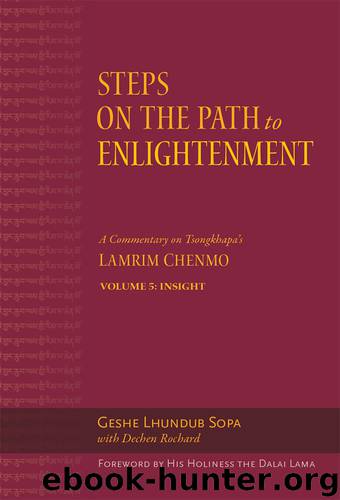
Author:Lhundub Sopa
Language: eng
Format: epub
Publisher: Wisdom Publications
(4')) REFUTING THE FOURTH MISINTERPRETATION
It seems that these scholars accept inherent existence conventionally, and yet they deny that it is able to bear ultimate analysis conventionally. This is wrong. As explained earlier, if inherent nature is accepted conventionally it must be able to bear ultimate analysis (see chapter 7).
These scholars also believe that according to the system of Candrakīrti, the Mādhyamikas prove something to their Realist opponents using an inference for another’s purpose, employing a reason that instantiates the three modes established by both the proponent and the opponent. However, this is not correct because in Clear Words Candrakīrti pointedly rejects Bhāvaviveka’s use of such syllogisms. In fact, he rejects the possibility of any debate using a mutually accepted subject and reason that instantiates the three modes, when one party accepts things to be truly existent and the other party rejects true existence. He further argues that if you accept this kind of syllogism, then you are committed to accepting all the characteristics of an autonomous logical reason, even if you do not use terminology such as “a reason proved by the power of reality.” For example, the lower schools, such as the Sautrāntika and the Yogācāra followers of reasoning, accept that an inherently existent reason has the power to prove a thesis by its own nature. Such a reason proves its thesis objectively through the power of reality.118
The meaning, as well as the implications, of accepting autonomous syllogisms and autonomous reasons will be dealt with in the context of differentiating between the logical methods used by the Svātantrika and the Prāsaṅgika systems to refute arising from self. There we will examine Candrakīrti’s powerful refutation of this kind of logic in great detail (see chapter 15). For now, Tsongkhapa says it is sufficient to note that it is completely wrong to claim that, according to Candrakīrti’s system, Mādhyamikas try to prove a thesis to their opponents by using inferences for another’s purpose rather than using consequences.
Download
This site does not store any files on its server. We only index and link to content provided by other sites. Please contact the content providers to delete copyright contents if any and email us, we'll remove relevant links or contents immediately.
The Way of Zen by Alan W. Watts(6621)
Ego Is the Enemy by Ryan Holiday(5456)
The Art of Happiness by The Dalai Lama(4133)
The Book of Joy by Dalai Lama(3996)
Why Buddhism is True by Robert Wright(3459)
Spark Joy by Marie Kondo(3310)
Shift into Freedom by Loch Kelly(3203)
Happiness by Matthieu Ricard(3054)
A Monk's Guide to a Clean House and Mind by Shoukei Matsumoto(2920)
The Lost Art of Good Conversation by Sakyong Mipham(2662)
The Meaning of the Library by unknow(2579)
The Unfettered Mind: Writings from a Zen Master to a Master Swordsman by Takuan Soho(2317)
The Third Eye by T. Lobsang Rampa(2273)
Anthology by T J(2217)
Red Shambhala by Andrei Znamenski(2207)
The Diamond Cutter by Geshe Michael Roach(2069)
Thoughts Without A Thinker: Psychotherapy from a Buddhist Perspective by Epstein Mark(2030)
Twilight of Idols and Anti-Christ by Friedrich Nietzsche(1899)
Advice Not Given by Mark Epstein(1884)
